

Anyone who’s spent time with a circular saw knows the drill. You mark your line, line up the blade, pull the trigger, and somewhere around the halfway mark the cut starts to wander.
Maybe you nudged the saw, maybe the wood grain pulled it, or maybe your hand just isn’t as steady as you thought. A guide rail or straightedge clamped to the board fixes this instantly, but not everyone has one lying around, and sometimes you just need to make one cut and don’t want to dig through the garage for a clamp that’s probably missing anyway.
The good news is that a straight cut is absolutely possible freehand; it just takes a bit more attention to a few details that most people skip.
Start With a Line You Can Actually See
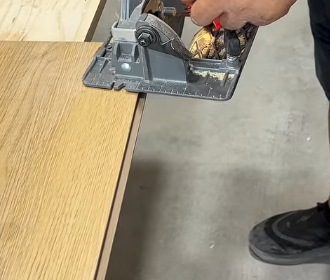
This sounds obvious, but it’s the number one reason freehand cuts go crooked. A faint pencil line disappears the moment sawdust starts flying, and once you lose sight of it, your eyes drift to the blade guard or your hands, and that’s when the saw drifts too.
Use a sharp pencil or a fine marker and press hard enough that the line stays visible even with a light dusting of debris on it. If you’re cutting plywood or anything with a rough surface, a carpenter’s pencil works better than a regular one because the flat lead won’t skate around.
Also, don’t just eyeball the line from one end. Use a square to mark it if you’re cutting across a board, or snap a chalk line if you’re going with the grain on something long like a sheet of plywood. A chalk line takes thirty seconds and gives you a perfectly straight reference the entire length of the cut, which is honestly half the battle right there.
Pay Attention to Where You’re Actually Looking
Most people watch the blade as it cuts, which feels natural but is actually working against you. By the time you notice the blade has drifted off the line, it’s already off the line, and correcting mid-cut usually makes things worse because you end up overcorrecting.
Instead, try to keep your eyes a few inches ahead of the blade, watching where the shoe of the saw is heading rather than where the blade currently sits. Most saws also have a notch or guide mark on the front of the base plate that lines up with the blade; use that as your reference point instead of trying to track the blade itself through the guard.
Let the Saw Do the Work, Don’t Force It
A lot of wandering cuts happen because people push the saw too fast or muscle it sideways when they think it’s drifting. Circular saw blades cut best at a steady, moderate pace. If you’re forcing the saw through the material, the blade can bind slightly and pull to one side, especially with a dull blade or if you’re cutting damp or knotty wood.
Let the saw’s own momentum carry it forward and just guide it, rather than pushing it like a lawnmower. If you feel resistance, back off slightly instead of pushing harder.
Use Your Body as the Stabilizer
Your stance matters more than people think. Stand with your feet shoulder-width apart, positioned so your body is naturally aligned with the direction of the cut, not twisted to one side.
Keep both hands on the saw if it has a front handle, and brace your arms against your body rather than holding the saw out at arm’s length, which amplifies every small wobble.
Some people find it helps to rest a knee or hip lightly against a sawhorse or the edge of the workbench for extra stability, basically turning your whole body into a more solid platform than your hands alone can provide.
Practice on Scrap First
If the cut actually matters, say it’s a finish piece for furniture or something visible, practice the exact same cut on a scrap piece of the same material first. This isn’t about skill so much as calibration.
Every saw feels a little different, base plates aren’t all exactly true, and blades vary in thickness and sharpness. A test cut tells you how your particular saw tracks and whether you personally tend to drift left or right, so you can adjust before it counts.
Consider a Cheap Straightedge Substitute
If you genuinely can’t get a straight cut freehand no matter what you try, you don’t need an official guide rail. A factory-edge strip of plywood, a metal ruler, or even a straight length of scrap lumber clamped down works just as well.
It takes an extra two minutes to set up but removes the guesswork entirely. This isn’t cheating; it’s just using what’s available, and even experienced carpenters reach for a straightedge on cuts that need to be precise.
Cutting straight with a circular saw freehand really comes down to visibility, pacing, and body control more than raw skill. Once you get a feel for your own saw and train your eyes to look ahead of the blade instead of at it, the cuts get noticeably more consistent.
It won’t be table-saw perfect, but for most home projects, framing work, and general carpentry, a steady freehand cut is more than good enough.
FAQs
Can you cut perfectly straight with a circular saw without any guide at all?
With practice, yes, close to it. Most experienced users can get within a millimeter or two over a few feet of cutting. For cuts where exact precision matters, like cabinetry, a straightedge is still worth using.
Why does my circular saw always drift to one side?
This is usually caused by a dull or slightly bent blade, pushing the saw too fast, or an off-square base plate. Check your blade condition first since that’s the most common culprit.
What blade is best for a straight freehand cut?
A sharp blade with more teeth, generally 40 to 60 for wood, gives a cleaner and more controlled cut than a coarse blade, which is more prone to grabbing and pulling.
Should I follow the blade or the base plate notch when cutting?
Follow the notch on the front of the base plate. It’s positioned exactly in line with the blade and is much easier to track accurately than watching the spinning blade itself.
Is it safe to freehand cut without a guide?
Yes, as long as you maintain a firm grip, keep your stance stable, and don’t force the saw. Most safety concerns with circular saws come from rushing the cut or losing control, not from the absence of a guide rail.

I’m Alex, the voice behind Saw Mentor. With years of real, hands-on experience in the tools industry, I’ve learned one thing: the right tool makes all the difference.
At Saw Mentor, I share straightforward advice, honest reviews, and practical insights to help you make smarter decisions without the guesswork.