

If your circular saw blade is not cutting straight, you’re probably standing in your garage right now staring at a cut that veers off like it has a mind of its own, wondering if you did something wrong or if the tool itself is the problem.
The honest answer is: it could be either, and sometimes it’s both at once. This happens to beginners and guys who’ve been building decks for twenty years alike.
A saw that wanders isn’t broken in some dramatic sense; it’s usually just fighting you on one of a handful of fronts, and once you know what to look for, fixing it takes minutes, not a trip to the hardware store for a new tool.
The Blade Itself Is Often the Culprit
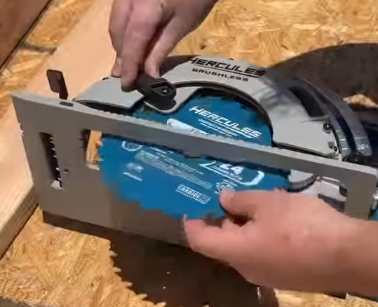
Start here before you blame your technique. A warped or bent blade will never cut a straight line no matter how steady your hands are. Lay it on a flat surface and look down the edge.
Any visible wobble or waviness means it’s toast. Heat from overuse, hitting a nail, or just cheap manufacturing can warp a blade over time.
Dull teeth cause a sneakier version of the same problem. Instead of slicing cleanly, a dull blade tends to push and grab unevenly, which pulls the saw off your line, especially in harder or knottier wood. If you’re forcing the saw through the cut instead of guiding it, that’s usually your first clue the blade needs replacing or sharpening.
Also check for pitch and resin buildup. Sap and sawdust bake onto the blade surface after a while, especially with softwoods, and that buildup changes how the blade interacts with the wood on each side. A quick soak in a degreaser or blade cleaner solves this one, and it’s shockingly overlooked.
Your Saw’s Alignment Might Be Off
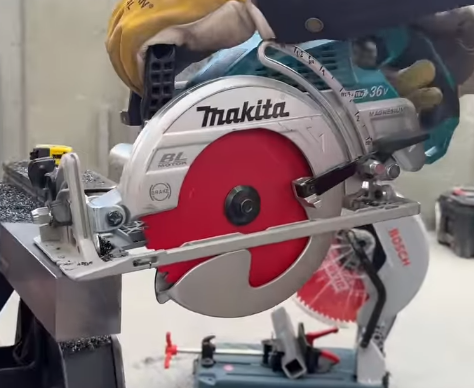
Circular saws have an adjustable base plate, often called the shoe, that needs to sit at a true 90 degrees to the blade for square cuts, and separately needs to line up correctly with the blade for straight ones. Bump the saw, drop it, or just wear it down over months of use, and that alignment drifts.
Use a square to check the shoe against the blade. If there’s a gap anywhere, adjust the bevel screws until it reads true. It only takes a couple of minutes, but it’s the single most common fix for saws that cut fine for a while and then mysteriously start drifting.
Loose arbor nuts are another quiet offender. If the blade itself can wobble slightly on the arbor because the nut isn’t torqued properly, you’ll get a wandering cut even with a perfectly sharp, perfectly flat blade. Give it a check with the wrench that came with your saw.
Technique Plays a Bigger Role Than People Admit
Even a perfect saw with a perfect blade will cut crooked in the wrong hands, and that’s not an insult; it’s physics. Pushing too fast forces the blade to work harder than it wants to, and it’ll take the path of least resistance rather than your intended line. Slow down, especially in dense material or when cutting against the grain.
Watch your line of sight too. A lot of people watch the blade guard notch instead of the actual blade, and that notch is rarely perfectly calibrated on cheaper saws. Look at where the blade itself meets the wood, not the little arrow stamped into the plastic.
Support matters just as much as speed. If your workpiece isn’t fully supported and it starts to sag or vibrate mid-cut, the blade will bind slightly and pull sideways. Use sawhorses positioned so the offcut falls away freely instead of pinching the blade as you go.
Wood Grain and Material Can Fight You Too
Sometimes the saw and your technique are both fine, and the wood is just being difficult. Dense grain, knots, or reclaimed lumber with internal stress can cause a blade to deflect slightly even when everything else is dialed in.
This is more common with rip cuts along the grain than crosscuts. A guide rail or straight edge clamped to the material takes the guesswork out of it entirely when you’re dealing with unpredictable wood.
A Few Things Worth Checking Before You Give Up
Run through this shortlist next time it happens: blade sharpness and flatness, shoe to blade alignment, arbor nut tightness, your push speed, and whether the material is properly supported. Nine times out of ten, the problem lives in one of those five spots.
FAQs
Why does my circular saw pull to one side even with a new blade?
A new blade doesn’t fix a misaligned base plate or a loose arbor nut, so check those first. Also confirm the blade is actually seated flush against the arbor flange. Even a tiny gap from sawdust or debris can cause a slight tilt.
Can a cheap blade cause crooked cuts?
Yes, and it’s more common than people think. Budget blades are more prone to warping from heat and often have inconsistent tooth grinding, both of which show up as drift in your cuts, especially in longer rip cuts.
How do I know if my saw’s base plate is out of square?
Hold a combination square against the shoe and the blade with the saw unplugged. Any visible light gap between the square and either surface means it needs adjusting through the bevel screws on the front of the saw.
Does blade size or tooth count affect straightness?
Not directly, but a mismatched blade for the material can indirectly cause problems. Too few teeth on fine material can grab and pull, while too many teeth on thick lumber can bog down and heat up faster, warping sooner.
Should I use a guide rail even if my saw is properly aligned?
It’s not strictly necessary, but it removes almost all human error from the equation, especially on long rip cuts. If you’re doing repeat cuts that need to be dead straight, a clamped straight edge or track saw guide is worth the extra setup time.
Thanks for taking the time to read this guide! We hope it helped answer your questions. If there is anything you would like to add or ask, feel free to leave a comment below. You can also explore more helpful articles on our website.

I’m Alex, the voice behind Saw Mentor. With years of real, hands-on experience in the tools industry, I’ve learned one thing: the right tool makes all the difference.
At Saw Mentor, I share straightforward advice, honest reviews, and practical insights to help you make smarter decisions without the guesswork.