

If you’ve ever stood in your garage holding a brand new blade and wondered which way should circular saw blade face before you tighten it down, you’re not alone. It’s one of those questions that seems obvious until you actually have the blade in your hand and realize the teeth aren’t symmetrical, and getting it backwards can ruin your cut, dull the blade fast, or even be dangerous.
The short answer is that the teeth should point in the direction the blade spins, which for almost every circular saw means the teeth face forward and down at the front of the blade, toward the material you’re cutting.
But there’s more nuance to it depending on whether you’re using a sidewinder saw, a worm drive, or a table saw, so let’s break it down properly.
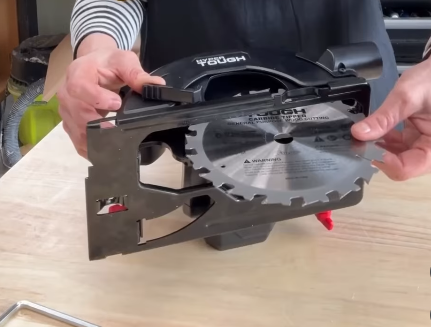
The Basic Rule
Look at the teeth on your blade. They have a slight hook or angle to them, almost like tiny hooks leaning in one direction. That lean tells you the direction of rotation. On a standard circular saw, the blade should be mounted so the teeth point toward the front of the saw and curve downward as they meet the wood.
When the motor spins the arbor, the teeth should be cutting into the wood on the downstroke at the front, which is what gives you a clean cut and pulls sawdust away efficiently instead of just grinding against the material.
Most blades have an arrow stamped right on the side showing rotation direction. If you’re ever unsure, that arrow is your best friend. It should match the direction of the arrow or marking on the saw’s blade guard housing. If those two arrows agree, you’re good to go.
Sidewinder vs Worm Drive Saws
This is where people get tripped up. A typical sidewinder saw, which is the kind most homeowners own, has the motor mounted to the side of the blade and the blade spins so that at the bottom of the saw, near where it meets the wood, the teeth are moving upward and backward, meaning they cut on the up stroke relative to the base.
A worm drive saw, on the other hand, has the motor positioned at the back, and because of how the gearing works, the blade actually spins in the opposite direction compared to a sidewinder even though both are cutting the wood correctly.
So if you swap a blade between these two saw types without paying attention, you could easily install it backwards. Always check the rotation arrow on the saw body itself rather than assuming based on habit from a different tool.
What Happens If You Install It Backwards
A backwards blade won’t just cut poorly, though it will do that too. You’ll notice burning on the wood, excessive vibration, a rougher edge than normal, and the saw working much harder than it should because the teeth are essentially scraping instead of slicing.
In some cases, the saw can kick back unexpectedly because the blade isn’t engaging the material the way it’s designed to. It’s also just hard on the blade itself, wearing down the carbide tips faster than normal use would.
If something feels off the moment you start a cut, like the saw is bogging down or smoking almost immediately, stop and double check the blade direction before you assume it’s a motor problem or a dull blade issue.
Table Saws Follow the Same Logic
The same principle applies to table saws, miter saws, and most other bladed power tools. Teeth point in the direction of rotation, and on a table saw that usually means the teeth at the top of the blade, the part sticking up through the table, are angled to cut downward into the material as the blade spins toward the operator and then back down through the table slot.
If you’ve ever changed a table saw blade and had it come out looking wrong once you started cutting, chances are it went in facing the wrong way.
A Quick Way to Check Yourself
Before locking any blade into place, spin it by hand if the saw is unplugged and disconnected from power, and watch which way the teeth are angled as they move. They should be angled to bite into the material in the direction the saw normally travels or the direction the blade descends.
If you picture the blade slicing a piece of wood like a knife dragging through butter at an angle rather than pushing straight in, that’s the orientation you want.
And honestly, when in doubt, just look for that little arrow. Manufacturers put it there for a reason, and it saves a lot of guessing.
FAQs
Can a circular saw blade be installed backwards without noticing right away?
Yes, unfortunately. It might still spin and even cut a little, just poorly, so some people don’t catch it until they see burn marks or feel the saw struggling more than usual.
Do all circular saw blades have a direction arrow?
The vast majority do, usually stamped or printed near the center hole. If yours doesn’t have one, look at the tooth angle itself as a backup, or check the manufacturer’s packaging or website for guidance.
Is the blade direction different for a worm drive saw compared to a sidewinder?
The blades themselves aren’t different, but because the motor placement changes how the gears turn the arbor, the rotation direction as viewed from the same side can appear opposite between the two saw styles. Always match the arrow on the saw housing.
What are the signs that a blade is facing the wrong way?
Burning on the cut edge, unusual vibration or noise, the saw bogging down more than normal, rough or splintered cuts, and the motor working harder than it should for the material being cut.
Does blade direction matter for cutting metal or plastic, not just wood?
Yes, the same rotation principle applies no matter the material. Metal cutting blades and plastic cutting blades still need the teeth angled correctly to shear the material rather than scrape it, and getting it backwards can damage both the blade and the workpiece.
Thanks for taking the time to read this guide! We hope it helped answer your questions. If there is anything you would like to add or ask, feel free to leave a comment below. You can also explore more helpful articles on our website.

I’m Alex, the voice behind Saw Mentor. With years of real, hands-on experience in the tools industry, I’ve learned one thing: the right tool makes all the difference.
At Saw Mentor, I share straightforward advice, honest reviews, and practical insights to help you make smarter decisions without the guesswork.
1 thought on “Which Way Should Circular Saw Blade Face?”